
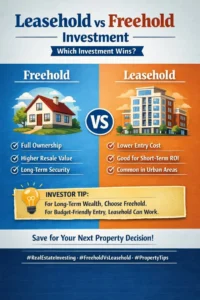
Understanding Freehold and Leasehold Properties Before You Buy
Buying a property is one of the most important financial decisions you will ever make. Before investing, it is essential to understand whether the property is freehold or leasehold, as this directly affects your ownership rights and future investment.
A freehold property gives you complete ownership of both the land and the building for an unlimited period. You can sell, transfer, renovate, or inherit the property without worrying about lease expiry. Freehold properties generally offer higher resale value, better appreciation, and easier home loan approvals.
A leasehold property, on the other hand, grants ownership for a fixed period, usually between 30 and 99 years, while the land remains owned by the government, authority, or original landowner. Although leasehold properties are often more affordable and located in prime areas, buyers should carefully check the remaining lease period, renewal conditions, and any restrictions on modifications or resale.
For most homebuyers, freehold property is the better choice because it provides permanent ownership, greater flexibility, and stronger long-term value. However, a leasehold property can be a suitable option if it fits your budget, is in a desirable location, and has a long lease remaining.
Before purchasing any property, always verify the title documents, ownership records, sale or lease deed, encumbrance certificate, property tax receipts, and required approvals. Conducting a professional property title investigation can help identify legal issues and protect you from costly disputes.
Understanding the difference between freehold and leasehold properties will help you make a smarter, safer, and more informed real estate investment.
A freehold property gives the owner complete and permanent ownership of both the land and the building constructed on it. Unlike a leasehold property, there is no fixed ownership period or requirement to renew a lease. The owner has full legal rights to use, sell, transfer, inherit, or renovate the property, subject to applicable local laws and building regulations. Freehold properties are generally considered more valuable because they offer greater security, higher resale potential, and long-term investment benefits. They are also easier to finance through home loans, making them a preferred choice for buyers seeking complete ownership and future financial stability.
Advantages and Disadvantages of Freehold Property.
A freehold property is often considered the most secure form of real estate ownership because it provides permanent ownership of both the land and the building. One of its biggest advantages is that the owner enjoys complete legal rights to use, sell, transfer, or inherit the property without worrying about lease expiry. Since there is no lease agreement, owners are not required to pay lease renewal or extension charges, making it a cost-effective option in the long run.
Freehold properties generally have higher resale value and better appreciation potential, making them an attractive investment. They are also preferred by banks and financial institutions, making it easier for buyers to obtain home loans. Additionally, owners have greater flexibility to renovate, extend, or modify their property, subject to local building regulations and municipal approvals.
However, freehold properties also have a few disadvantages. They usually come with a higher purchase price compared to leasehold properties, which may not suit every buyer’s budget. Furthermore, the owner is solely responsible for all maintenance costs, property taxes, repairs, and legal compliance. Despite these responsibilities, the long-term benefits of complete ownership, financial security, and investment growth make freehold properties the preferred choice for most homebuyers and real estate investors.
What is a Leasehold Property?
A leasehold property gives the buyer the right to occupy and use a property for a fixed period under a lease agreement, while the ownership of the land remains with the original landowner, government authority, or developer. Lease terms typically range from 30 to 99 years, although some may be longer. During the lease period, the leaseholder can use, sell, or transfer the property according to the lease conditions. Once the lease expires, ownership rights may return to the landowner unless the lease is renewed or extended. Buyers should always review the lease terms carefully before purchasing a leasehold property.
Advantages of Leasehold Property
- Lower Purchase Price: Leasehold properties are generally more affordable than freehold properties.
- Budget-Friendly: A good option for first-time buyers and people with a limited budget.
- Prime Locations: Often available in well-developed urban and commercial areas where freehold properties are limited.
- Lower Initial Investment: Buyers can own property with a smaller upfront investment.
Disadvantages of Leasehold Property
- Limited Ownership: You own the property only for the duration of the lease.
- Lease Renewal Costs: Extending or renewing the lease may require additional payments.
- Lower Resale Value: The property’s value may decrease as the remaining lease period becomes shorter.
- Loan Challenges: Banks may be less willing to provide home loans for properties with short lease terms.
- Approval Required: Major renovations, transfers, or structural changes may require permission from the landowner or the concerned authority.
Top of Form
Bottom of Form
Freehold vs Leasehold Property: Feature-by-Feature Comparison
| Feature | Freehold | Leasehold |
| 🏡 Ownership | Permanent ownership of the land and building | Ownership for a fixed lease period |
| 🌍 Land Rights | You own the land | The land is owned by the lessor |
| ⏳ Duration | No time limit | Fixed term, usually 30–99 years |
| 💰 Purchase Cost | Higher | Lower |
| 📈Investment Value | Better long-term appreciation | Appreciation depends on the remaining lease term |
| 🔄 Resale | Easier to sell | Resale value may reduce over time |
| 🏦 Home Loan | Easier bank approval | Depends on lender and lease period |
| 🛠 Renovation | More flexibility to modify | Approval may be required from the lessor |
| 📄 Lease Renewal | Not applicable | Required after lease expiry |
| ✅ Best For | Long-term homeowners and investors | Budget-conscious buyers and short-term investors |
Quick Summary
| Freehold Property | Leasehold Property | ||||||||||||||
| Which Property is Better? The best choice depends on your budget, investment goals, and how long you plan to own the property.
Conclusion:
|